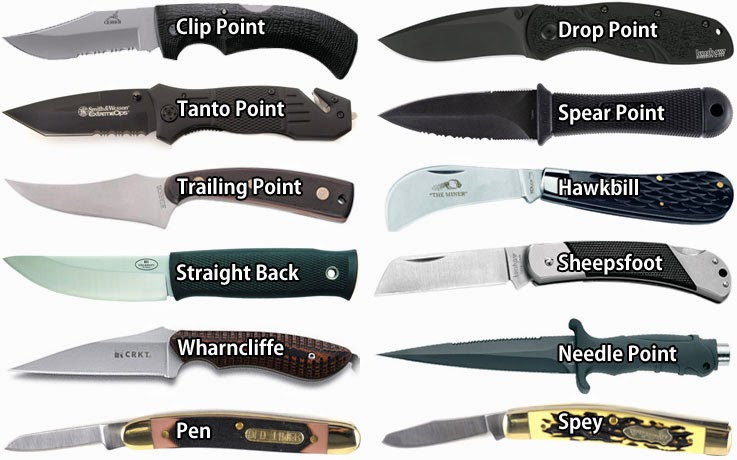
Blade material is an extremely important aspect of any knife. And there are many types of steel used for knife blades. Some are relatively soft steels, which may dull fairly quickly but be easily re-sharpened. Other steels may be very hard, and so can be ground to an extremely sharp edge, but they may be susceptible to chipping or break easily if used inappropriately (for prying, for example).
In the world of knife steel, there is always a compromise between strength (ductility, or the ability to bend rather than snap), hardness (ability to withstand impact without deforming), edge-retention, and corrosion-resistance. Typically, as one characteristic increases, another will decrease.
For example, some of the strongest, toughest knives are only moderately sharp (comparatively speaking), and are very susceptible to rust. But with proper maintenance, they can offer a lifetime of hard use that would damage or destroy a knife made from a different kind of steel.
The choice of blade steel will impact the appropriate usage of the knife, its ease or difficulty of manufacture, and of course, its price. Let's have a brief look at some of the more popular choices of blade steel available.
A Brief Primer on Blade Steel
All steel is composed of iron, with some carbon added to it. Various grades and types of steels are created by adding other "alloying" elements to the mixture. "Stainless" steel, by definition, contains at least 13% chromium. "Non-Stainless" steels are also known as carbon steels or alloy steels.
Despite its name and late-night TV reputation, stainless steel is not stainless. Like all steel, it too will rust. The high chromium level in stainless helps to decrease corrosion, but cannot entirely prevent it. Only proper maintenance and handling will keep your knife completely rust free. (And basically, that simply means keeping it clean and dry, lightly oiling it from time to time, and not storing it in a sheath. Just that simple. Oh yeah: no dishwashers. Ever.)
Speaking very generally, there are three grades of steel used for knife blades: Good, Better and Best. Each type of steel has unique properties that make it more suitable to specific designs and applications. And of course, the choice of steel will impact the knife's price.
Good Blade Steel
Knives utilizing "Good" steel blades should be considered entry-level, and tend to be made from rust-resistant (not rust-free -- see above) stainless steel. Typically manufactured in Asia, these knives offer a fairly good economic value. These blades are usually 'softer' and therefore require more frequent sharpening to keep the edge performing well. But, because they are in fact 'softer,' re-sharpening is fairly easy. Some of the more popular stainless steel blade materials in this class are 420, 440A and 7Cr13MoV.
420 stainless steel has a little less carbon than 440A. Many knife makers use 420 because it's inexpensive and it resists corrosion fairly well. 420 steel sharpens easily and is found in both knives and tools.
The relative low-cost and high corrosion resistance of 440A stainless steel makes it ideal for kitchen-grade cutlery. While exhibiting similar characteristics to the better-grade AUS 6 steel, it is considerably less expensive to produce. 440A contains more carbon than 420, and is therefore a 'harder' steel. This allows better edge retention than a blade made from 420, but is more difficult to re-sharpen.
7Cr13MoV is a good blade steel, that has the alloying elements molybdenum (Mo) and vanadium (V) added to the matrix. Molybdenum adds strength, hardness and toughness to the steel, while also improving its machinability. Vanadium adds strength, wear-resistance and toughness. Vanadium also provides corrosion resistance, which is seen in the oxide coating on the blade.
Better Blade Steel
Better grade stainless steel blades contain a higher chromium (Cr) content than their entry-level counterparts. Since the amount of chromium is increased in the manufacturing process, these blades are more expensive. Chromium provides a greater edge holding capability, which means that the blade will require less frequent sharpening. These better grade knives sharpen reasonably easily, but it's important to employ proper sharpening techniques. The combination of great value and performance make these blades perfect for everyday use. Examples of these types of steel are AUS 6, AUS 8, 440C and 8Cr13MoV.
Both AUS 6 and AUS 8 are high-grade chromium Japanese steels, which provide a great balance of toughness, strength, edge retention and corrosion resistance, all at a moderate cost. These blade steels will measure a hardness of 56-58 on the Rockwell hardness scale (HRc). The carbon content of AUS 8 is close to 0.75%, which makes it very suitable as a blade steel. AUS 6 and AUS 8 are very popular with many knife manufacturers because they are both cost-effective and good-performing steels.
440C is a reasonably high-grade cutlery steel, similar to the AUS series. However, 440C contains more carbon, which increases the steel's hardness. Its toughness and relative low-cost make 440C stainless steel appealing to many knife manufacturers for their mid-range knife series.
The Chinese stainless steel 8Cr13MoV has a high performance-to-cost ratio. It is often compared to AUS 8. 8Cr13MoV is tempered to a hardness range of 56-58 on the Rockwell scale. This relatively high hardness can be attributed to the steel's higher molybdenum and vanadium content.
Best Blade Steel
Both the United States and Japan manufacture the best grade stainless steel for knife blades. Unfortunately, the higher chromium content in these blade steels comes at a premium price. The addition of elements such as vanadium and chromium offer superior edge sharpness and retention, as well as very high rust-resistance. These steels are utilized for more demanding tasks such as hunting and fishing, tactical self-defense, and military applications. A sampling of steels in this group would include CPM 154, CPM S30V, VG-10 and San-Mai steels.
American-made CPM 154 premium grade stainless steel was originated for tough industrial applications. This steel combines the three principal elements of carbon, chromium and molybdenum. CPM 154 provides excellent corrosion resistance with good toughness and edge quality. Well-renowned for its overall performance as a knife blade steel, CPM 154 touts a hardness of 57-58 on the Rockwell scale.
CPM S30V, a powder-made stainless steel, was developed by Crucible Metals Corporation (now Crucible Industries). Noted for its durability and corrosion resistance, it is considered to be one of the finest steels ever created. The chemistry of CPM S30V promotes the formation and balanced distribution of vanadium carbides throughout the steel. Vanadium carbides are harder, and thus provide better cutting edges than chromium carbides. Additionally, vanadium carbides provide a very refined grain in the steel which contributes to the sharpness and toughness of its edge.
VG-10 is a high-end Japanese steel, manufactured by Taekfu Special Steel. Its matrix includes vanadium, a large amount of chromium, molybdenum, manganese and cobalt. The vanadium contributes to wear-resistance (edge retention), and enhances the chromium's corrosion-resistance. The molybdenum adds additional hardness to the steel. The overall combination of elements results in a very tough, durable steel. As such, VG-10 is a well-renowned blade steel specially designed for high-quality cutlery. Blades made from VG-10 can be ground to a razor-sharp edge and still offer extreme durability without becoming brittle. Blade hardness for VG-10 is around 60 on the Rockwell hardness scale.
San-Mai (Japanese for "three layers") is a composite steel used in many of the high-end knives manufactured by Cold Steel. The blade's core is a layer of VG-1 steel, sandwiched between outer layers of 420J2 steel. San-Mai steel blades offer superior durability and excellent corrosion resistance, important to those who depend on their knives for hunting and fishing, as well as tactical and military applications.
Different Steels for Different Uses
As you can see, not all blade steels are equal. Some are harder than others, but will be more brittle or apt to chip, while some may be stronger or hold a better edge, but be more difficult to sharpen once they've become dull.
A quality designer or manufacturer will select the appropriate blade steel for a knife based on the properties of the steel, in concert with the intended application of the knife. Think about the difference between the chef's knife in your kitchen compared to a knife used for underwater diving, or a knife used in a combat or military application.
Knowing a little about the characteristics of different blade steels will help you make the right choice when it comes time to purchase your next knife.
Want to know more about knives and knife blade steel? Hop on over to Knight Owl Survival Store for a closer look into the fascinating alchemy involved in creating the diverse variety of steels used in modern knives and swords.
Are you hunting for a new knife? Be sure to check out our assortment of practical, tactical and survival knives. We feature world-class knives from the best manufacturers, designers and craftsmen: Columbia River, Cold Steel, SOG and more! Find the Knife that Fits Your Life!
Article Source: http://EzineArticles.com/?expert=Mark_S_Zehnle
Are you hunting for a new knife? Be sure to check out our assortment of practical, tactical and survival knives. We feature world-class knives from the best manufacturers, designers and craftsmen: Columbia River, Cold Steel, SOG and more! Find the Knife that Fits Your Life!